


In November, I attended and moderated a panel at the MOps-Apalooza conference from the marketingops.com community. This post covers some of the sessions I attended, as summarized for LinkedIn posts and now here in one place, for your convenience.
A previous post can be viewed here.
Certifying the Future of Marketing Ops: Beyond the Tools
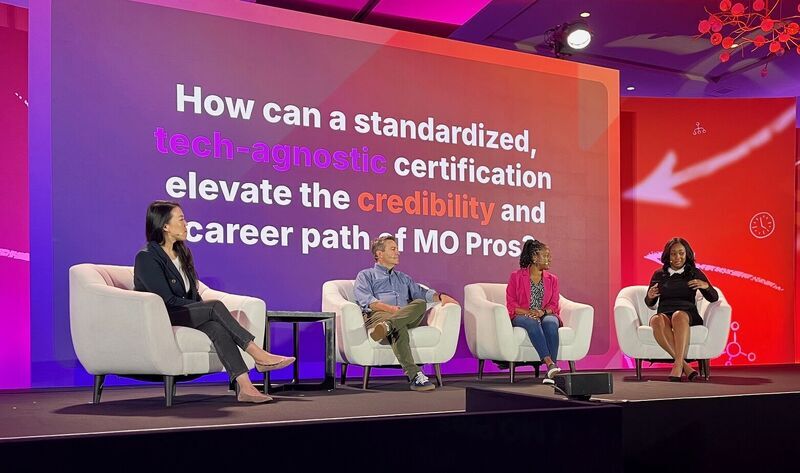
A MOps-Apalooza panel on ‘Certifying the Future of Marketing Ops: Beyond the Tools’ featured Naomi Liu, Eric Hollebone, Britney Young, and Mary Souza.
The current state:
-
52% of companies offer no formal training.
-
33% of marketing ops pros have no clear career path.
-
65% rely on on-the-job experience for growth.
A professional certification for marketing ops would be valued by 75% of people surveyed, for increased clarity, confidence, structure, validation, and benchmarks for growth.
How can a standardized, tech-agnostic certification elevate credibility and career paths?
Eric said software certifications don’t reflect a person's value. The certification has to enable people to speak in revenue terms to the rest of the company, such as the CFO. If we get certification programs into universities, marketing ops professionals can learn to be business-savvy from the start.
Mary spoke about the need to speak financial-ese to get buy-in and how a certification can help define the role of marketing ops, which currently looks different for everyone. It would help move it away from technical, ticket-taker roles and toward greater credibility and visibility within companies.
What should a certification measure to validate strategy, systems thinking, and cross-functional leadership —not just tool clicks?
Britney talked about how certifications should teach how to measure outcomes with strategic impact, so you need to learn a business mindset.
Eric said we need to teach problem-solving and critical thinking. Engineering is problem-solving with constraints, so borrow their curriculum.
In other fields, certification drives measurable results:
-
81% of graduates see promotions.
-
33% salary increase for PMP-certified professionals.
Marketing Ops mirrors that need:
-
27% cite leadership misalignment.
-
26% lack of recognition as the top barrier.
How do we keep certification relevant as trends and tech evolve?
Mary talked about understanding that things will change and rolling with it, as other certifications compensate for changes. At the beginning of our careers, a lot of us got certifications for our resumes, but we need ‘soft’ skills: communicating, problem-solving, and more than the technical piece.
Britney said so much has changed in tools, but soft skills and the need for a strategic mindset don’t change.
Eric spoke about a 3-track system, with higher leadership tracks being peer-reviewed:
-
Tech, always evolving
-
Business sense
-
Change management, people management – people haven’t evolved in 10,000 years, while tech evolves constantly
What skills are most important in marketing ops?
Mary and Britney said how to interact with stakeholders, such as reading the room, explaining issues and fixes concisely, and making future predictions.
Eric emphasized the importance of active listening for identifying triggers throughout the conversation and conflict resolution skills. Thinking in other people’s shoes to get agreements.
Thank you for this great panel!
The Influence Framework: Turning Operational Work into Business Wins – Earning Trust, Influence, and a Seat at the Table.
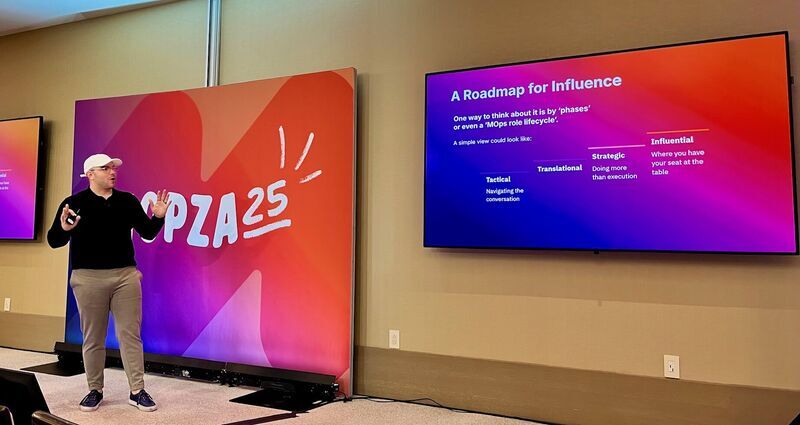
Akande Davis spoke at MOps-Apalooza on marketing ops earning influence in the company.
When everything is on FIRE…
Who cares about alignment?
How do we get into those conversations before things break?
During Akande’s time as an in-house resource, he wanted to help the company grow in a meaningful way; however, he was typically:
-
Troubleshooting sync issues
-
Approving, changing, re-approving emails
-
Chasing down unsubscribes
-
List imports
-
Figuring out why Outlook hates everyone
-
Explaining GDPR
-
Fighting for budget
Where he really wanted to spend time:
-
Designing scalable campaign architectures
-
Testing new Martech tools and emerging channels
-
Developing long-term frameworks for attribution, lead scoring, and more
-
Translating data into insights for leadership
-
Partnering with Sales, Product, & RevOps to align on data and process
He found out that he wasnʼt alone!
These were challenges that EVERYONE ran into.
Ops gets locked into doing things we’re not passionate about.
How do you transition from tech to strategy?
Getting a seat at the table is challenging.
But you can get leadership visibility even if you're not in a boardroom.
How to translate Ops Into Revenue:
- Automation is really: A way that marketing operations is impacting a business outcome.
- An autoresponder & sales alert drives speed-to-lead and sales velocity
- Data normalization enables accurate and reliable reporting
Reframe projects in business terms, by speaking the language of leadership:
Instead of:
“We built a new workflowˮ or “We cleaned the databaseˮ
Say this:
“We reduced lead response time by 30%.ˮ or “We improved campaign deliverability and tracking.ˮ
- Operational levers are actually:
- Growth levers that require a technical resource to execute.
- The time of day, content, and cadence of a nurture program directly impacts MQLs and score.
- Lead qualification thresholds determine the quantity and quality of prospects.
While operational activities can be tied to growth, you donʼt have to tie everything to ROI to prove value. Leading indicators like velocity, conversion quality, & confidence are great areas where operational improvements lead to growth.
- Every execution is also:
- An opportunity to become a trusted internal advisor.
- Internal postmortems on requests/campaigns can bring to light wins and areas of opportunity in a non-biased, neutral way.
- When a project is owned by the execution arm, improvements to processes and can be made and benchmarked against.
A roadmap for influence:
A simple view could look like:
-
Tactical: Navigating the conversation
-
Translational
-
Strategic: Doing more than execution
-
Influential: Where you have your seat at the table
Great Execution Is Brass Tacks For Everything.
Marketing ops is the foundation behind Marketing, Sales, Customer Success, and even impacts Company Goals and Market and Board Influence.
Thank you, Akande!
How to start sharing your operations knowledge
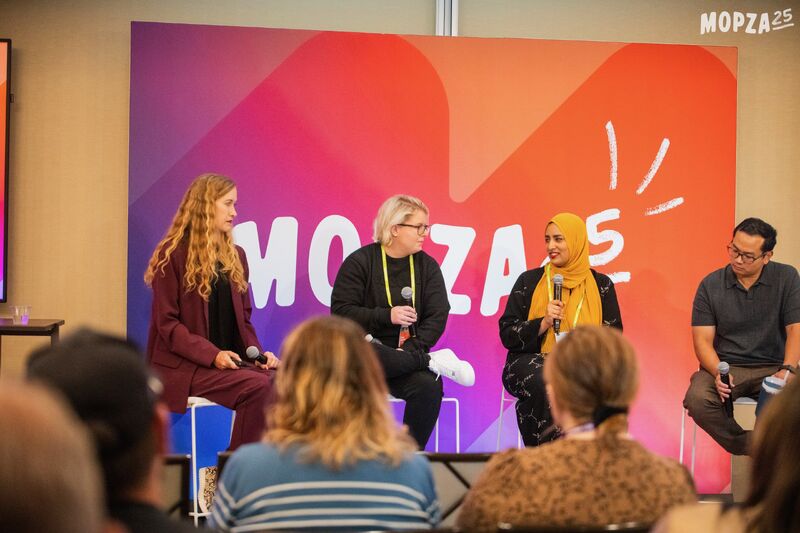
Now we’ve reached the summary for the panel I moderated, ‘How to start sharing your operations knowledge’ featuring Darrell Alfonso, Sara McNamara, and Alysha Khan.
1. How did you decide what topic to start sharing about?
Sara lived somewhere without a tech community, and after a layoff, wanted to move to California. She needed to build a network and get known there, so she started posting on LinkedIn.
Alysha had difficult jobs that taught her a lot she wishes she had known earlier, especially about Marketo, so she started making videos about that for people early in their careers or new to that tool.
Darrell discussed the various reasons for sharing and how each reason is distinct and influences the writing you do. So think about what you want to do, because the monetization piece is kind of a slog.
Alysha mentioned not monetizing yet because then publishing would be on a forced cadence, instead of sharing when the idea struck.
2. How do you identify which of your daily ops experiences are actually worth sharing with people?
Sara aims to discuss what people aren’t talking about that could be helpful, or what people can relate to about the work that is hard. She talks with peers and coworkers and asks if they are experiencing the same thing and are suffering in silence.
Alysha goes for a strong opinion, a ‘I really wish somebody had told me this before I wasted the last hour of my life.’ moment, or when she’s wandering around the house muttering to herself about something.
Darrell said when you see other people's writing, and you think there's a better or other way to do it or say it, that's a good place to start. Or building on that, Sara said.
3. Where did you start sharing your knowledge, and why did you choose that location/channel?
Darrell started content creation on the Marketo forum, where you would answer people's questions to try to help, and the super experts would correct you. It was incredibly intimidating and deterred a lot of people. He kept going and set a goal to write every day in the community; also, since it was gamified, there were points.
Alysha studied journalism and always liked writing, so she started there, writing a blog post and putting it on LinkedIn. She began speaking more after joining the Marketo Champion Program, but initially chose the medium in which she felt most comfortable.
Sara added that when you first start posting, if there's not a lot of interaction, that is not a failure. You're getting the reps in, you're finding your voice, you're figuring out what resonates.
Alysha said even if people don't have the immediate reaction, you still have a chance to stick in the back of somebody's head. There will be somebody who will be influenced, and then they will pass that knowledge on to the next person.
Read the rest of the summary in another blog post, since this was especially tough to condense to LinkedIn's 3000 character count!
A Sprinkel-ing of Tips, Tricks, and Hacks From My 15-year MOPs Career
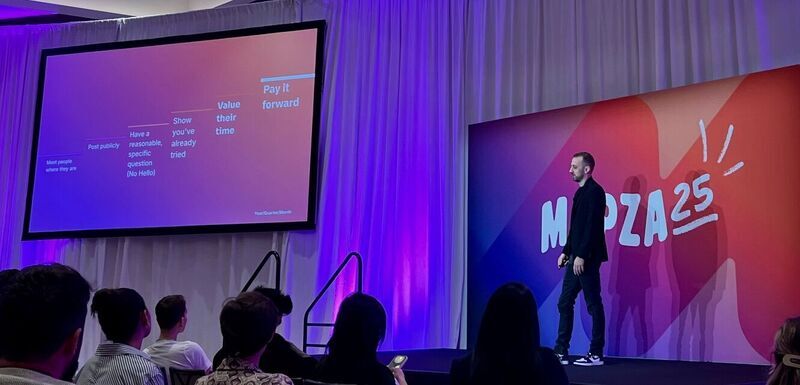
Todd Sprinkel did indeed give a wide variety of advice! Some of which included or related to:
General marketing ops:
-
Always plan for scale. Spend 8 hours now to save yourself 10 minutes 100 times in the future.
-
Use ISO 8601 Date Formats (e.g. 2025-10-29)
-
Don’t create ‘wait steps” to allow X to happen
-
Indent your formulas and code, instead of using an unformatted paragraph/list, and add /Comments*/ to your Salesforce formulas: /****DO NOT TOUCH BELOW THIS LINE****/
- Thou Shalt Not Develop in Production - Use a sandbox
- Use global forms
-
Date to ISO 8601 String =TEXT(A2,"yyyy-mm-dd")
-
Useful Keyboard Shortcuts (too many to summarize!)
-
Is Duplicate? =IF(A2=A1,1,0)
-
In other list?= IF(ISNUMBER(MATCH(A2,DD,0,))1,0)
-
Get list of related records = TEXTJOIN(",",TRUE,FILTER(E:E,A2=D:D))
-
Use Office scripts for repetitive work
HubSpot:
-
Verify Sync to SFDC Before Adding to Campaign
-
Advanced logic is now possible. No more duplicating logic groups!
Marketo:
-
There is a direct link to double click into any Contact record from Lead Database
-
Use the Marketo /supportTools
-
Use the new global token to avoid an unnecessary folder in your tree
-
Executable vs Requestable, Synchronous vs. Asynchronous Processing - DO or QUEUE. Do I need this RIGHT NOW? Or can queue because I don't care when it finishes?
Salesforce:
-
Inspector Reloaded browser extension
-
UnofficialSF AppExchange
-
15-to-18 Digit IDs. You can also create a formula field CASESAFEID( Id )
-
Campaign Structure
-
Classic Merging in Lightning
-
Custom Metadata Types, Custom Labels, etc.
-
Power of 1. Custom Formula Field on main objects - Return 1
-
Difference in Business Hours Formula
-
Run Rate Formula
-
Get All Fields from an Object
-
Trailhead/Free Developer Edition
How to Get FREE Help from Experts:
-
Meet people where they are. Join Slack communities, product communities, user groups, etc.
-
Post publicly. Ask your question in public. Feel free to tag anyone specific, but don't message unless it's specifically about their work. Give others a chance to help.
-
Have a reasonable, specific question (Not just saying Hello --> Go straight to jail.). Provide details of your ask upfront–don't wait for someone to reply before providing details like expectations, or steps to reproduce and any error messages. If you can, provide links, screenshots, etc.
-
Demonstrate that you've already tried. Use Google, reference documentation/forums related to what you're trying to do. Put in the effort before asking for help and SHOW that you made the effort.
-
Value their time. Say thank you. Offer to pay for their time if what you need is beyond a quick question.
-
Pay it forward. Network religiously. Help others where you can. They are much more likely to want to help you if they see you giving back to the community.
Thank you, Todd!
Three learnings from Mopza 2025
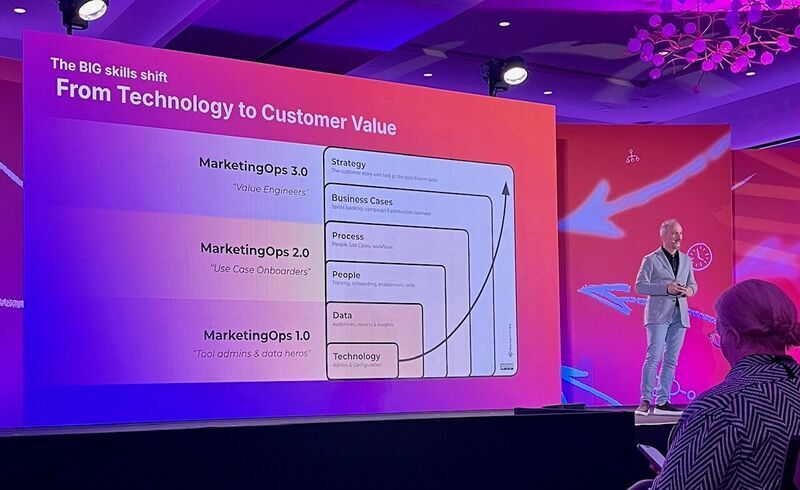
Frans Riemersma spoke about ‘Three learnings from Mopza2025.’
With all the tech and data we have access to, why don’t we have excellent customer experiences?
What if we didn’t have all that tech and data? What would we do?
Ingvar Kamprad, the founder of IKEA, was dyslexic and didn’t have easy access to technology/data. It made him always start with the customer. He is talking to you through the furniture, connecting with the customer, in a constant dialogue in the store. He invented the furniture names due to dyslexia, so he wouldn't have to use SKU numbers.
With clients, the first question Frans asks is: What can you switch off?
The BIG skills shift.
From Technology to Customer Value.
Software is easier to operate now; you don't need years of engineering to create it.
Drive Technology Value with Martech.
Drive Technology Value with AI – new org charts, startups with one marketer and 40 AI agents.
Drive Technology Value with Martech + AI:
How is your Technology Aligned with Strategy?
Assess the company across strategy, process, and tech maturity.
Strategy maturity should be higher than process maturity, which should be higher than tech maturity.
How Do Your Tools Compare to Outperformers?
How Well are your Requirements Aligned?
What if we benchmark stacks based on value?
“Stop implementing software.
Start implementing customer business casesˮ
~ Value Engineering, a method that enables a company to generate revenue by focusing on the customer.
MarketingOps 1.0: Tool admins & data heroes
MarketingOps 2.0: Use Case Onboarders
MarketingOps 3.0: Value Engineers
Storytelling = Data + Soul.
~ Brenée Brown
“The customer talks to you, through the dataˮ
~ Frans
2. Drive Customer Value
Value Engineering = Customer Business Cases.
Make a business case.
ALWAYS.
Build Portfolio: 20% Business Cases drive 80% of revenue.
Segment Sources. Use the Segmentation Matrix.
Not all data is equal. No information is also information.
“The best antidote against uncertainty is experimentation.ˮ
~ Alex Atzberger
“Become the company's Sherlock Holmes with a pitbull mentality. ˮ
~ Value Engineering - Do Whatever It Takes
30% of time management involves dealing with completely unfeasible requests.
Frans also asked the audience to share their top learnings from MOPZA, such as:
Start with the customer experience and work your way back to technology.
“AI doesn’t have to be the answer to everything.” AI is a strategy like a Ferrari is a strategy. It's not. It’s a tool. Even Google doesn't know what to do with AI to make it useful, Frans said.
Focus on the long term.
Frans said that only 10% of CEOs have an affinity for marketing; they have no clue what to do.
Tool utilization: 30% is a high number.
We think it should be 90-100% but that is stressful and unnecessary.
Pendo usage data: only 12% of features are used the most.
Thanks, Frans!
This was the final session I attended in person.
Taking Mops to the Moon: A C-Suite Perspective
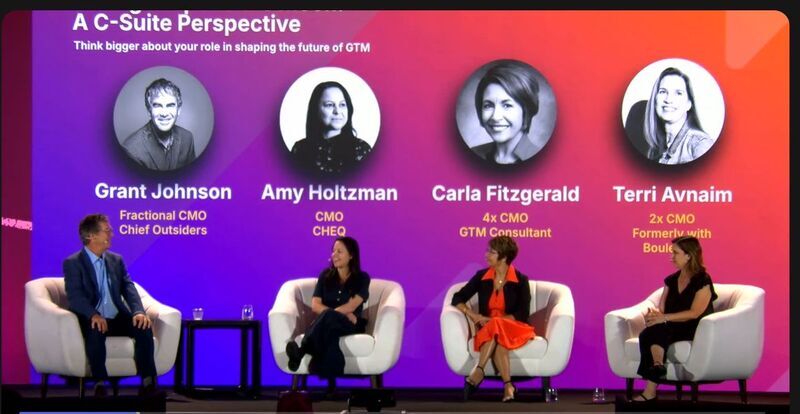
I began watching MOps-Apalooza recordings, starting with: Taking Mops to the Moon: A C-Suite Perspective, with Terri Avnaim, Carla Fitzgerald, Amy Holtzman, and moderated by Grant Johnson.
LinkedIn limits character count, so I chose just a few questions.
How should CMOs coach marketing ops pros who want to take on more strategic roles?
Terri said to expose yourself as much as possible to the other areas of marketing. And always be asking the why behind the projects you're working on, so you get more of the business-centric context.
Carla said to focus on ‘what problem are we trying to solve today?’ so leadership sees you as someone who helps get to the goal. Marketing ops has a tendency to think all problems are solved by technology. But consider a number of different capabilities as solutions, and the way all the components fit together cross-functionally.
Amy said to think beyond marketing. Earlier in our careers, we thought about the impact we have ON marketing. But marketing fits into the much bigger picture of business strategy. Think about who is benefiting from this project? Why is the company doing this, and how does my part fit in?
What’s the right balance between speed and structure in operations?
Amy said it depends on what the project and the ask are. Underlying infrastructure that deeply impacts the business has to be incredibly well thought out and integrated with the bigger picture, and those things take time. Other projects we just need to get out the door; perfect isn’t required, it won’t have a bigger impact, so speed is more important.
Carla said it depends on the maturity and size of the organization. Early-stage companies rely on speed because they are trying to establish themselves in the market. The larger and more mature orgs can’t scale, and are spinning wheels if they don't focus on structure.
Terri said it depends on if it needs to be repeatable. Marketing ops rarely works on a one-and-done project; almost everything is a repeatable process, where structure needs to come before speed.
What challenges have you faced when trying to align marketing ops across departments?
Carla said what’s harder is getting what they do elevated at a strategic level so people can appreciate and understand how valuable that work is and not take it for granted.
Terri said a common tension point is with finance. Finance thinks if you can make it work in a spreadsheet, why can’t marketing make it work in the real world? She’s spending time educating finance about the length of the sales cycle because they think she’s spending this money in March and getting the opportunities in March.
Amy said it depends on where marketing ops sits. Sometimes there is a need to align with marketing. Sometimes, there is a greater need to align with other ops teams. Collaboration & sharing DOCUMENTATION 🎉 become really important. Legal can be hard to align with, since our industry and tools move faster than legal may understand.
Centralized MOPS, Decentralized Impact: Scaling Global Digital Marketing with Limited Regional Resources
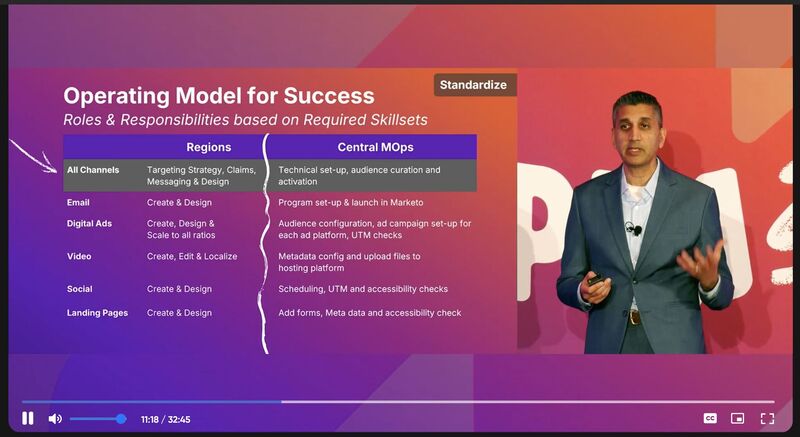
I recently watched the recording for ‘Centralized MOPS, Decentralized Impact: Scaling Global Digital Marketing with Limited Regional Resources’ from Ajay Parikh.
He discussed how he scaled global digital marketing by changing the operating model without adding any additional headcount.
Doing more with less using the S3 Framework:
Stabilize
Standarize
Scale
Stabilize:
Fix what’s broken or inconsistent, find and map pain points.
Remove chaos and clarify ownership, roles, and responsibilities.
Standardize:
Stop firefighting, start planning.
Create clear, repeatable processes and templates.
Make best practices the norm.
Scale:
Build on and reuse what works to do more with less.
Replicate success across regions.
When he was interviewing for the job in 2018, on paper it looked good: a familiar tech stack, a large marketing team… but reality quickly set in.
IT was pinch-hitting marketing ops.
No one knew the martech systems… or even the passwords.
Only a few global markets were doing any digital marketing.
AND the brick wall was that their marketers weren’t creating content. They were outsourcing to agencies that built everything in Photoshop and Illustrator, so even the most minor changes required a technical gatekeeper.
This process was slow and expensive.
That’s not how you scale a global business.
Ajay set up a new operating model to centralize the marketing ops team.
Unlocking speed, accuracy, and impact meant building repeatable systems and empowering these regional teams with support, tools, and consistency that they needed.
In the new model, regional marketing teams now handle targeting, claims, messaging, and design.
The centralized ops team does the technical execution.
(See slide photo)
To get out of inbox chaos from global requests, he created an intake workflow for smart prioritization using a single request form.
He also moved marketing ops further upstream, so ops team members talk to marketers to understand their needs, guide them to the best solutions, and ensure the creative work is optimized to best practices before it is approved.
Email previously cost $8-10K to develop each one, so increased speed with governance was really important. He started using no-code tools to multiply output across regions for banner ads (resizing), videos, emails, and landing pages, saving $250K a year.
Compliance = Speed if you:
Standardize where possible.
Localize where Necessary. (only swap out the materials legally required for compliance, and localization of language)
So compliance is the guardrails, not handcuffs.
Foundational S3 Lessons:
-
Find your Bottlenecks. Tools & headcount won’t solve process debt. Map the pain first.
-
Divide work based on skills required, not org chart. Let marketers focus on content.
-
Compliance can be a speed lever. Standardize where you can, localize where you must.
-
Alignment is the force multiplier to scale global capability.
Plot it Like It's Hot: Building a Marketing Operations Roadmap That Delivers
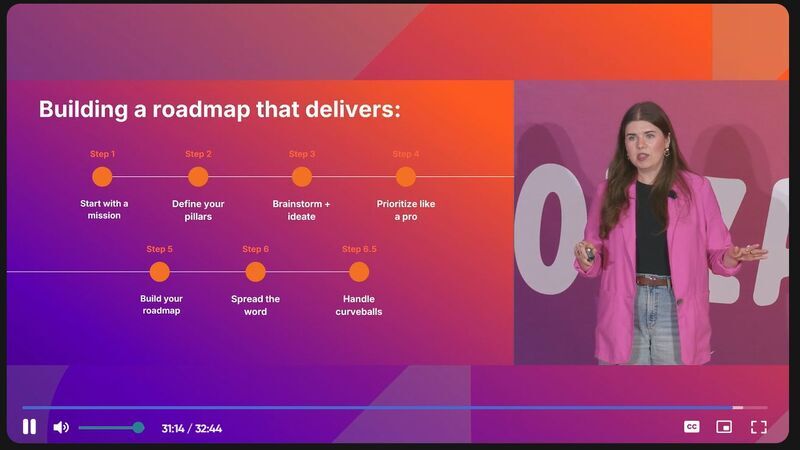
My final summary of a Mops-Apalooza panel is ‘Plot it Like It's Hot: Building a Marketing Operations Roadmap That Delivers’ from Kelsea Morrison.
She explained the roadmapping process she used in her role that made marketing ops recognized as a strategic partner and innovation leader.🎉
Step 1: Start with a mission – to keep your roadmap aligned throughout changes.
Example: “Our mission is to be the backbone of the marketing organization, ensuring seamless operations and continuous improvement. We use our expertise in data, technology, and process management to drive efficiency, creativity, and measurable resultsˮ
-
Start with the why
-
Keep it short & actionable
-
Involve key stakeholders, but NOT 'decision by committee'
-
Make it aspirational but realistic
-
Revisit annually
Step 2: Define your pillars, the key areas of responsibility that give your team clarity, focus, and guardrails.
(Learned from Darrell Alfonso)
- Align pillars to your mission
- Use pillars as filters, gut check new ideas/requests
- Shows the balance across your work long term
- Get stakeholder buy-in to align expectations of team responsibilities
- Keep them flexible
Step 3: Brainstorm what *could* be on the roadmap
- Set the stage, capture everything, no judgment
- Use diverse inputs: Pain points, tech debt, leadership goals, innovations, stakeholder requests, upcoming launches
- Choose an interactive tool
- Group similar ideas using the pillars
- Let the team contribute first, add your ideas last
Step 4: Prioritize what *should* be on the roadmap
- Team members place each idea onto a prioritization matrix
- They explain their placement
- Facilitate open debate
- Reshuffle and finalize together
Step 5: Build your roadmap as an actionable, time-bound plan
- The best format is whatever one you will actually use
- Start with the must-dos. Assign owners, start & end date, realistic capacity
- Add the highest priority big projects/rocks before pebbles and sand-sized projects
- Layer in smaller tasks, add quick wins for motivation and to show leadership your progress
- Create a linked backlog for “not nowˮ projects
Step 6: Spread the word to earn trust, visibility, and alignment.
Roadmap = Communication Tool
- Frame it as a story of driving growth and scale, not a spreadsheet
- Tailor the message and the amount of details to your audience
- Set expectations up front to reduce random requests
- Make it a living document that people can access
- Share it publicly
Step 6.5: How to handle curveballs – such as last-minute requests
Use your roadmap as armor to protect your team and strategic vision.
- Pause before saying yes or no
- Use your roadmap as a decision lens
- Make the trade-offs visible
- Create a “parking lotˮ or backlog
- Debrief after major changes to the map
We discuss roadmaps in the RevOps bootcamp, and I think Kelsea provided excellent guidance in this session!
Pretty Funny Business Live and MOps Trivia
Part of the final event of the conference was a live recording of the podcast 'Pretty Funny Business' from Sydney Mulligan and Lauren Aquilino. If you have a subscription, you can view it here or below.
Then there was a marketing ops trivia contest, ending with the top scorers competing in a Jeopardy-like showdown.
If you have a Pro membership, you can view the trivia and Jeopardy here.